
Out of Thin Air

One of the last two steamships fitted with sails, huge spread of canvas, three steel masts to court the wind, she delivered my father’s family to the new world, from the cargo hold called ‘Tween Decks the space reserved for rudder controls and the emigrants.
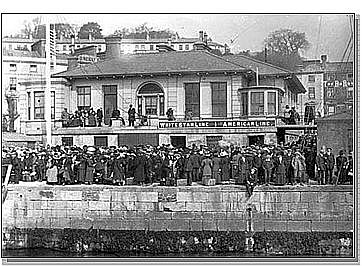
The RMS Etruria, precursor to the Lusitania and Titanic, her two towering funnels running the North Atlantic 1885-1909, the ship of new emigrants, one week from Queenstown and Liverpool to New York, she ran 19 knots, 7718 tons, 158 meters long with 5 decks.
500 in First Class, 160 in Second, 800 in steerage, she delivered us 200 to 400 per section with dinner pails, makeshift bunks, stench and stale air. My grandmother’s kin arrived Ellis Island July 15, 1905, nine o’clock in the morning:
On board, one Bridget Grady, 18 years, single, servant, able to read and write, has a ticket—final destination: Aunt, Catherine Grady in Chicago.
The new immigrants had to have a place to go. They were ‘tween people neither there nor here; they had to fit in, too many to count, too powerless to matter.
My granddad was a hod carrier, toting mortar for bricklayers and plasterers.
From the 1930 Census, Chicago, Cook County, Illinois:
Martin Cassedy, 35, rent, immigrant, 1905? Naturalized? Or 1909? Occupation illegible.
Agnes (Grady) Cassedy, wife, 30, immigration 1907? Alien, Irish spoken in the home.
Son, Thomas Cassedy, 16, no schooling.
I knew my Dad as a fun and gentle man, accomplished, competent, his past a mystery.
He’d fashioned himself out of thin air.
2012


